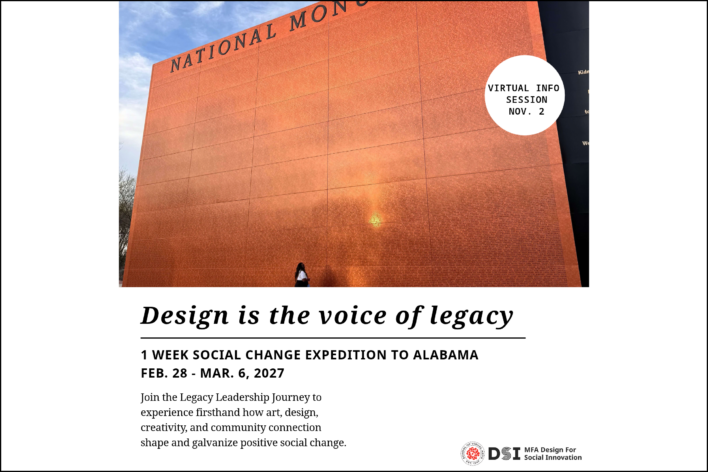
Info Session: Legacy Leadership Journey to Alabama
Date: Monday, November 2, 2026
Time: 7 – 8 pm ET
Location: Virtual
Register for virtual info session HERE
Join us November 2 to learn more about this one-week social change leadership experience that takes place in Montgomery, Birmingham, and Selma, Alabama – the birthplace of the Civil Rights Movement. We experience firsthand how art, design, and creativity shape, inspire, and galvanize change worldwide. The program includes visits to museums, memorials, and monuments, as well as reflective interactions with social leaders, designers, and artists. We visit several historical sites in Montgomery, including the Equal Justice Initiative’s Legacy Sites, Rosa Parks Museum, Freedom Rides Museum, Dexter Avenue King Memorial Baptist Church, Alabama State Capitol, and more. In Birmingham, we visit sites such as the 16th Street Baptist Church, the Birmingham Civil Rights National Monument, and the Birmingham Civil Rights Institute. In Selma we cross the Edmund Pettus Bridge, the legendary site of the march from Selma to Montgomery.
Participants study the complex history of racial injustice in the United States through the work of civil rights leaders (Rosa Parks, Dr. Martin Luther King Jr., Jo Ann Robinson, John Lewis, among others) who fought for social justice and the freedoms that we all benefit from today. We examine the impactful relationships among activism, creativity, and leadership in light of historical and current events and critical contemporary issues.
Visiting historical places, people, cultures, and events firsthand can change attitudes and beliefs, test our values, and prompt us to rethink our behaviors, perspectives, and approaches. By walking the paths of “ordinary people doing extraordinary things,” meeting with local leaders and engaging with local artists and designers, we more fully understand what it means to lead and partake in social change movements. We share and analyze the critical conditions and social design intentions that emerge from these immersive experiences.
The program starts with two pre-sessions to orient and learn about the trip, and culminates in the creation of a collective artifact (community quilt) capturing both individual experiences and collective learnings about what it means to be a “good ancestor.” Upon return to SVA, students will also design and share a presentation of key takeaways from their journey, facilitated by a group session. The aim is to gain self-awareness, knowledge, and compassion; to develop empathy for how this history relates to contemporary issues; and to inspire our future legacies as creative leaders committed to justice, truth, healing, and reconciliation.
For further information, contact Riley Ladner, program coordinator, via email at rladner@sva.edu or by phone at 212.592.2200.